Cooling Tower: High-Efficiency and Environmentally Friendly Solutions in Industrial Cooling
Cooling Towers are systems used to cool water in places with high heat loads, such as industrial facilities, large buildings, and power plants. These systems are based on the principle of reducing the temperature of the remaining water by evaporating a portion of it. In this way, they provide energy efficiency and operational continuity by constantly supplying the cold water needed by industrial processes or air conditioning systems.
How Does It Work?
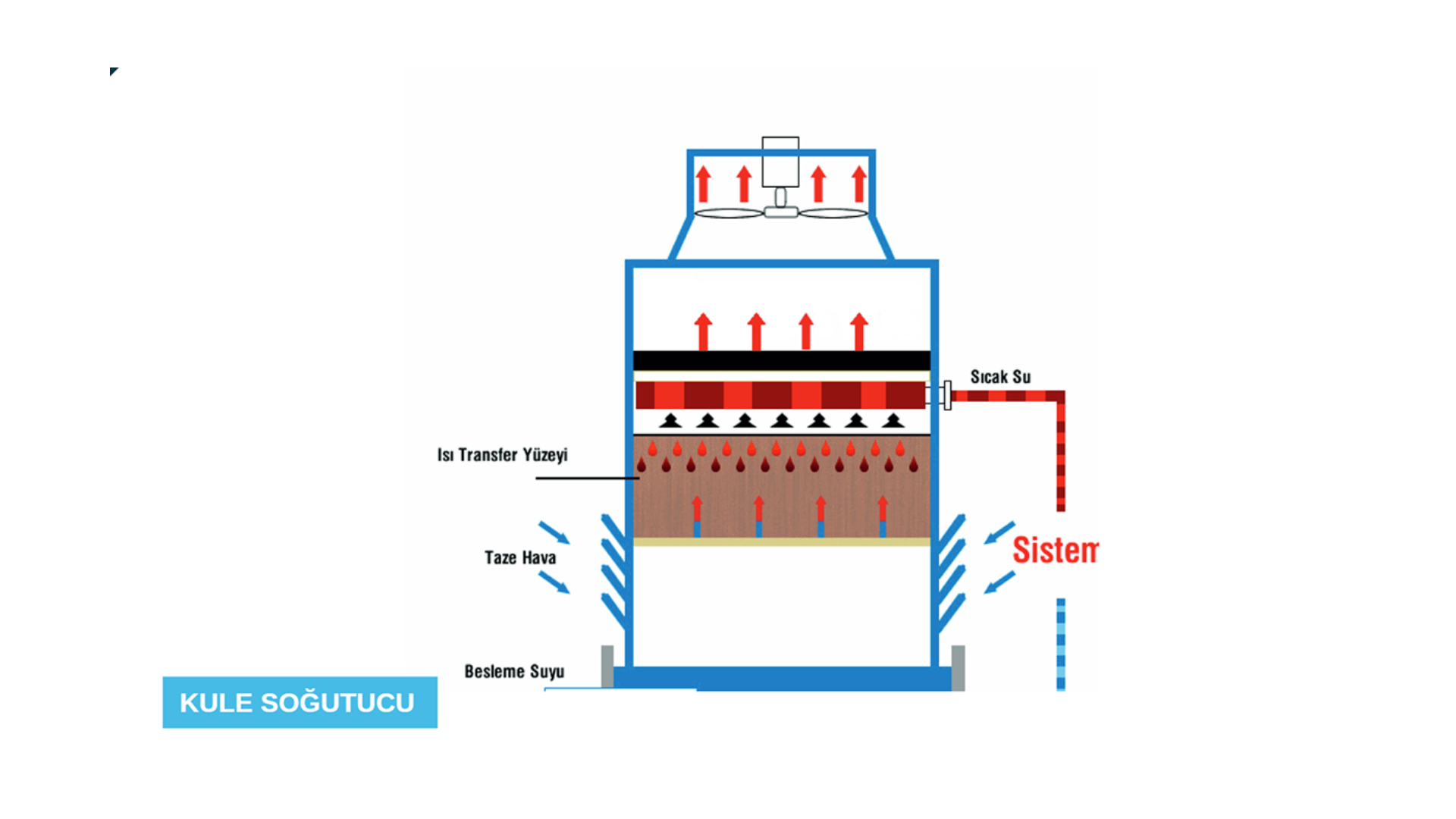
The cooling tower carries the hot water to the top of the tower via a pipeline. Here, the water flows downwards in thin droplets over a special packing material (fill). Simultaneously, air taken from outside via a powerful fan moves upwards through the water droplets. With the direct contact of air and water, a portion of the water evaporates. The heat contained in the water during evaporation is transferred to the air, and the heated air is expelled from the tower. The cooled water is collected in a basin at the bottom of the tower and is pumped back into the system for reuse.
Energy Efficiency and Environmentally Friendly Approach
Cooling towers generally consume less energy than closed-loop cooling systems because they use fans and pumps instead of high-energy-consuming components like compressors. This provides a significant reduction in operating costs. In addition, water saving is also possible by reusing the water. With an environmentally friendly approach, it reduces thermal pollution by transferring waste heat directly into the air.
Application Areas and Advantages
Cooling towers are used in a wide range of different sectors:
-
Power Plants: For cooling generators.
-
Petrochemicals and Refineries: For temperature control of production processes.
-
HVAC Systems: In the air conditioning systems of large-scale buildings.
-
Food and Beverage Production: For cooling production lines.
These systems are an indispensable part of industrial facilities with their high cooling capacity, low energy consumption, and long-lasting structure.